
Income Tax- New Forms applicable from 01st April, 2026!
IntroductionThe shift from the Income Tax Act, 1961 to the Income Tax Act, 2026 has introduced major structural and procedural updates, including renumbering, consolidation, and streamlining of statutory forms. While the essence of compliance; covering audit reports, TDS/TCS filings, certificates, and declarations; remains intact, the form numbers and section references have been significantly revised. Tax professionals and stakeholders must realign their systems and processes to ensure accuracy and seamless compliance under the new regime. Change in Form Name/Number Form No. (1962) Form No. (2026) Description 3CA,3CB,3CD 26 Audit report and Statement of particulars 3CEA 28 Report of an accountant relating to computation of capital gains in slump sale 10BA 31 Declaration for deduction for rents paid 3CEB 48 Report from an accountant relating to international transaction(s) and specified domestic transaction(s) 29B 66 Computation of Book Profit 29C 67 Report for Computation of Adjusted Total Income and Alternate Minimum Tax 12BA 123 Statement showing particulars of perquisites, fringe benefits, amenities, profits in lieu of salary 12BB 124 Statement showing particulars of claims by employee for deduction of tax 16A 131 Certificate for tax deducted at source 16B,16C,16D,16E 132 Certificate for tax deducted at source 49B(1) 134 Application for allotment of TAN (Government Entity) 49B(2) 135 Application for allotment of TAN (Other Entities) 24Q 138 Quarterly statement of deduction of tax on salary/senior citizen income 26Q 140 Quarterly statement of deduction of tax on payments other than salary 26QB,26QC,26QD,26QE 141 Challan-cum-statement of deduction of tax 27EQ 143 Quarterly statement of collection of tax at source 27Q 144 Quarterly statement of deduction of tax on payments to non-residents 15CA 145 Information for payments to non-resident/foreign company 15CB 146 Certificate of accountant for payments to non-resident/foreign company 27BA 150 Form for furnishing accountant certificate 26AS 168 Annual information statement Form No. (1962) Form No. (2026) Description 3BB 1 Monthly statement to be furnished by a stock exchange in respect of transactions in which client codes have been modified… 5B 2 Application for notification of a zero coupon bond under section 2(112) of the Act 5BA 3 Certificate of an accountant under rule 7 3CT 4 Income attributable to assets located in India under section 9(10)(a) of the Act 3AF 5 Statement regarding preliminary expenses incurred by the assessee to be furnished under Section 44(3) of the Act 3AE 6 Audit Report under section 44(6) / 51(7) of the Act 3CG 7 Application for approval of scientific research programme under section 45(3)(c) of the Act 3CH 8 Order of approval of Scientific Research Programme under section 45(3)(c) of the Act 3CI 9 Receipt of payment for carrying out scientific research under section 45(3)(c) of the Act 3CJ 10 Report to be submitted by the prescribed authority to the Chief Commissioner of Income-tax after approval of scientific research programme 3CK 11 Application for entering into an agreement with the Department of Scientific and Industrial Research for cooperation in In-house research development facility 3CL 12 Report to be submitted by the prescribed authority to the Chief Commissioner of Income-tax having jurisdiction over the company 3CLA 13 Report from an accountant relating to in-house scientific research and development facility 3CM 14 Order of approval of in-house research and development facility 3CF 17 Application for approval of a company or institution under section 45(3)(b) and 45(4)(b) 3CN 18 Application for notification of affordable housing project as specified business 3CS 19 Application for notification of semiconductor wafer fabrication manufacturing unit as specified business 3C-O 20 Application for approval of agricultural extension project 3CP 21 Form for notification of agricultural extension project 3CQ 22 Application for approval of skill development project 3CR 23 Form for notification of skill development project 3CE 24 Audit Report 3C 25 Form of daily case register 5C 27 Details of amount attributed to capital asset remaining with the specified entity 62 29 Certificate from amalgamated company regarding production level 10-IA 30 Certificate of medical authority for disability, autism, cerebral palsy etc. 56FF 33 Particulars to be furnished 10DA 34 Report for deduction in respect of additional employee cost 10CCF 35 Report for deduction in respect of Offshore Banking Units 10CCD 36 Certificate for Authors of certain books in receipt of Royalty Income 10CCE 37 Certificate for Patentees in receipt of royalty income 10H 38 Certificate of foreign inward remittance 10E 39 Form for claiming relief 10-EE 40 Exercise of option 10F 41 Information to be provided 10FA 42 Application for Certificate of residence 10FB 43 Certificate of residence 67 44 Statement of income from a country or specified territory outside India and Foreign Tax Credit 3CEFA,3CEFB,3CEFC 49 Application for opting for Safe Harbour 3CEC 50 Application for a pre-filing consultation 3CED,3CEDA 51 Application for an Advance Pricing Agreement (APA) 3CEF 52 Annual Compliance Report on Advance Pricing Agreement 3CEEA 53 Form for filing particulars of past years for calculating relief in tax payable 34F 55 Application for invoking mutual agreement procedure in agreements with other countries 3CEAA 56 Information and document to be furnished by constituent entity 3CEAB 57 Intimation by designated constituent entity of international group 3CEAC 58 Intimation by constituent entity of international group (parent not resident in India) 3CEAD 59 Report by parent/alternate reporting entity of international group 3CEAE 60 Intimation on behalf of international group 10FC 61 Authorisation for claiming deduction in respect of payment to financial institution in notified jurisdiction 3CEG 62 Reference to Commissioner of Income-tax by Assessing Officer 3CEH 63 Returning the reference made under section 274 3CEI 64 Reference to Approving Panel and satisfaction recording by Commissioner 3CFA 65 Opting for taxation of income by way of royalty in respect of patent 10-IG 68 Statement of exempt income under Schedule VI 10-IH 69 Statement of income of Specified fund eligible for concessional taxation 10-IK 70 Annual Statement of exempt income and concessional income for offshore banking unit 10-IL 71 Verification by an Accountant 64E 72 Statement of income paid/credited by securitization trust 64F 73 Statement of income distributed by securitisation trust to investor 64 74 Statement of
TDS Rates for FY 2026-27
✨ Introduction Tax Deducted at Source (TDS) is a key compliance mechanism under the Income Tax Act, ensuring tax collection at the point of income generation. For FY 2026-27 (Tax Year 2026-27), effective from 1st April 2026, the Income Tax Act 2025 (New) consolidates most provisions into Section 393, simplifying compliance while retaining familiar rates. This guide provides a detailed table of applicable TDS rates for payments to residents and non-residents, along with compliance notes. 🏠 Table – For Payment to Residents Sr No. Old Act Section New Act Section Ref Serial No. Nature of Payment Applicable Payer Threshold Limit TDS Rate 1 192 392 N/A Salary Any employer Basic exemption limits Slab rates 2 194H 393 1 Commission or brokerage Any person ₹20,000 2% 3 194I(a) 393 2 Rent – Land/Building/Furniture Any person other than Individual/HUF ₹50,000 per month 10% 4 194I(b) 393 2 Rent – Plant/Machinery/Equipment Any person other than Individual/HUF ₹50,000 per month 2% 5 194IB 393 2 Rent by Individual/HUF Individual/HUF ₹50,000 per month 2% 6 194IA 393 3 Transfer of immovable property (other than agricultural land) Any person ₹50,00,000 (stamp duty value or consideration, whichever higher) 1% 7 194IA 393 3 Capital gain on development agreement (Sec 67(14)) Any person Nil 10% 8 194IA 393 3 Compensation/enhanced consideration Any person ₹5,00,000 10% 9 194K 393 4 Income from mutual fund units/specified company units Any person ₹10,000 10% 10 194K 393 4 Distributed income Business Trust Nil 10% 11 194K 393 4 Income from investment fund units Investment Fund Nil 10% 12 194K 393 4 Income from securitisation trust Securitisation Trust Nil 10% 13 194A 393 5 Interest (other than securities) Specified persons ₹50,000 (banks/co-op), ₹1,00,000 (senior citizens), ₹10,000 (others) 10% 14 194C 393 6 Payments to contractors Specified persons ₹30,000 single / ₹1,00,000 aggregate 1% / 2% 15 194J(a) 393 6 Professional services Specified persons ₹50,000 10% 16 194J(b) 393 6 Technical services Specified persons ₹50,000 2% 17 194 393 7 Dividend Any person Nil 10% 18 194Q 393 8 Purchase of goods Buyer turnover > ₹10 Cr ₹50,00,000 0.10% 19 194DA 393 8 Payment from life insurance policy Any person ₹1,00,000 2% 20 194P 393 8 Senior citizen income (after deductions/rebate) Specified bank Basic exemption limits Slab rates 21 194R 393 8 Business/professional perquisites Specified person ₹20,000 10% 22 194O 393 8 E-commerce transactions E-commerce operator Nil 0.10% 23 194S 393 8 Transfer of virtual digital assets Any person Nil 1% 🌍 Table – For Payment to Non-Residents Sl No. Nature of Income Payee Payer Rate 1 Income of non-resident sportsman/entertainer Non-resident Any person 20% 2 Interest on foreign currency loans/bonds (pre-2023) Non-resident/foreign company Indian company/trust 5% 3 Interest on rupee denominated bonds (pre-2023) Non-resident/foreign company Indian company/trust 5% 4 Interest on IFSC listed bonds Non-resident/foreign company Indian company/trust 4% (till June 2023), 9% (after July 2023) 5 Interest from infrastructure debt fund Non-resident/foreign company Debt fund 5% 6 Distributed income from business trust Non-resident unit holder Business trust 5%–10% 7 Mutual fund units/specified company units Non-resident Any person 20% (subject to DTAA) 8 Offshore fund units Offshore fund Any person 10% 9 LTCG on offshore fund units Offshore fund Any person 12.5% 10 GDRs/bonds – Interest/dividends Non-resident Any person 10% 11 GDRs/bonds – LTCG Non-resident Any person 12.5% 12 Securities income (FII) FII Any person 20% (subject to DTAA) 13 Securities income (specified fund) Specified fund Any person 10% 14 Other interest/sums (not salaries) Non-resident/foreign company Any person Rates in force 📌 Notes ✅ Conclusion The FY 2026-27 TDS framework consolidates provisions under the Income Tax Act 2025, streamlining compliance while tightening rules around dividends, VDAs, and e-commerce transactions. With reduced thresholds and expanded coverage, taxpayers must ensure timely deduction and deposit of TDS to avoid penalties. This structured approach makes compliance easier for businesses, professionals, and individuals while aligning taxation with evolving financial and digital transactions.
CBDT Sets 31st March 2026 as Last Date for TDS/TCS Correction Statements (FY 2018–19 to 2023–24)
Introduction Tax compliance in India has undergone significant transformation over the past decade, with digitization and stricter monitoring ensuring greater transparency in reporting. One of the most critical aspects of compliance is the accurate filing of Tax Deducted at Source (TDS) and Tax Collected at Source (TCS) statements. These statements form the backbone of the tax credit system, directly impacting taxpayers’ ability to claim deductions and refunds. Recognizing that errors in these filings can cause long-term complications, the Central Board of Direct Taxes (CBDT) has provided a final window for corrections. The CBDT has announced that 31st March 2026 will be the cut-off date for filing correction statements for financial years 2018–19 to 2023–24. After this date, no further corrections will be permitted. This announcement is a wake-up call for deductors and collectors to review their past filings and ensure accuracy before the deadline. — Understanding TDS/TCS Correction Statements TDS and TCS are mechanisms designed to collect tax at the source of income. Deductors (employers, businesses, or institutions) and collectors (entities responsible for collecting tax at source) are required to file quarterly statements detailing the tax deducted or collected. However, errors often creep in due to: · Incorrect PAN entries of deductees. · Wrong challan details. · Mismatches in amounts deducted or collected. · Technical errors during uploading on the TRACES portal. Correction statements allow deductors and collectors to rectify these mistakes. Once filed, the corrected data flows into the taxpayer’s Form 26AS and Annual Information Statement (AIS), ensuring proper credit of taxes. — Why the 31st March 2026 Deadline Matters The CBDT’s decision to fix a final deadline has far-reaching implications: · Closure of Past Years: Financial years 2018–19 to 2023–24 cover six years of filings. This window is the last chance to clean up errors in these years. · Impact on Taxpayers: If corrections are not filed, taxpayers may face mismatches in their records, leading to denial of credit or delays in refunds. · Compliance Risk: Deductors who fail to correct errors may face queries during assessments or audits, as mismatched data often triggers scrutiny. · System Efficiency: By closing corrections after March 2026, the Income Tax Department aims to streamline records and reduce the burden of managing legacy data. — Common Errors That Need Correction Before the deadline, deductors and collectors should carefully review their filings for the following issues: · PAN Errors: Incorrect or invalid PAN entries prevent tax credits from reflecting in the deductee’s account. · Challan Mismatches: Wrong challan numbers or amounts can lead to discrepancies in tax payment records. · Deductee Details: Errors in names, addresses, or amounts deducted can cause mismatches in AIS. · Quarterly Statement Errors: Missing or wrongly reported transactions in quarterly TDS/TCS returns. — Action Plan for Deductors and Collectors To ensure compliance before the deadline, organizations should adopt a structured approach: 1. Review Past Statements: Conduct a thorough audit of TDS/TCS filings for FY 2018–19 to FY 2023–24. 2. Identify Errors: Use reconciliation tools to compare filed data with challans, books of accounts, and deductee records. 3. File Corrections Promptly: Submit correction statements through the TRACES portal well before the deadline. 4. Maintain Documentation: Keep records of corrections filed, acknowledgments, and supporting documents for audit purposes. 5. Communicate with Deductees: Inform employees, vendors, or clients if corrections affect their tax credits. — Practical Guidance for Smooth Compliance · Avoid Last-Minute Rush: The TRACES portal may experience heavy traffic closer to the deadline. Filing early reduces the risk of technical glitches. · Seek Professional Help: Chartered Accountants (CAs) and tax consultants can review filings to ensure accuracy. · Leverage Technology: Use compliance software to identify mismatches and generate correction files. · Stay Updated: Monitor CBDT notifications for any clarifications or procedural changes. — Implications for Taxpayers While the responsibility of filing correction statements lies with deductors and collectors, taxpayers must remain vigilant: · Check Form 26AS and AIS: Ensure that tax credits are correctly reflected. · Follow Up with Deductors: If discrepancies exist, request the deductor to file corrections before the deadline. · Plan Refunds Accordingly: Incorrect data may delay refunds or lead to disputes during filing. — Broader Compliance Perspective This move by the CBDT reflects a broader trend in tax administration: · Data Accuracy: The government is emphasizing accurate reporting to reduce disputes. · Digital Integration: With AIS and pre-filled returns, errors in TDS/TCS data directly affect taxpayers. · Finality of Records: By setting a cut-off, the department ensures closure of past years, allowing focus on current and future compliance. — Conclusion The 31st March 2026 deadline is not just a procedural announcement, it is a decisive step towards ensuring accuracy and finality in tax records. Deductors and collectors must treat this as a compliance priority, acting well in advance to avoid last-minute hurdles. Timely corrections will safeguard deductors from penalties and scrutiny while ensuring taxpayers receive accurate credit for taxes paid. For businesses, professionals, and individuals alike, this is the last opportunity to clean up six years of data. By acting now, stakeholders can avoid complications, build trust in compliance systems, and contribute to a smoother tax administration process.
Quarter-End Compliance Checklist for Businesses | GST & TDS
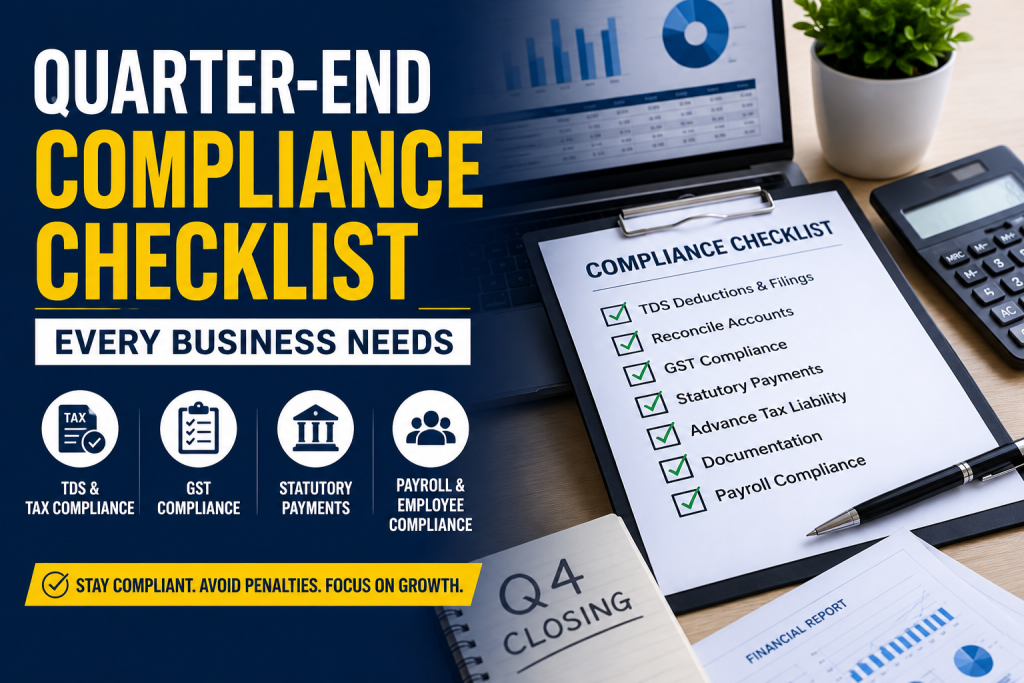
Quarter-end is not just about closing books—it’s about ensuring your business stays compliant, penalty-free, and audit-ready. Whether you’re a growing startup or an established enterprise, missing even a small compliance task can lead to financial and legal complications. A structured checklist can significantly impact the difference between a smooth close and last-minute chaos. Here’s a practical quarter-end compliance checklist every business should follow to stay on track. 1. Review TDS Deductions and Filings Start by verifying all Tax Deducted at Source (TDS) entries for the quarter. Ensure that: Once verified, proceed with timely return filing. Delays or errors can lead to penalties and notices, so accuracy is critical. 2. Reconcile Books of Accounts Reconciliation is essential to maintain financial accuracy. Compare your: Identify mismatches and resolve them before the quarter ends. This helps avoid discrepancies during audits and ensures reliable financial reporting. 3. GST Compliance Check Ensure all GST-related activities are completed: Incorrect GST filings can lead to blocked credits and compliance risks, so cross-checking is a must. 4. Verify Statutory Payments Confirm that all statutory dues are paid on time, including: Late payments attract interest and penalties, impacting your business financially and legally. 5. Check Advance Tax Liability Evaluate your business income and calculate any advance tax payable. Paying advance tax on time helps avoid interest under applicable tax provisions. It also ensures better cash flow planning for the business. 6. Documentation and Record Keeping Organize all financial documents for the quarter, such as: Maintaining proper documentation ensures smooth audits and quick responses to any notices from authorities. 7. Payroll and Employee Compliance Review payroll records and ensure: Employee-related compliance is often overlooked but plays a key role in overall financial accuracy. Conclusion Quarter-end compliance doesn’t have to be stressful if approached systematically. With a clear checklist and timely action, businesses can avoid penalties, maintain accuracy, and stay fully compliant. More importantly, it allows teams to focus on growth rather than firefighting compliance issues. Adopting the right tools and processes can further simplify this journey, making compliance not just a requirement—but a competitive advantage.
Advance Tax Calculation FY 2025-26 (AY 2026-27) – Key Pointers
Introduction Advance tax is a cornerstone of income tax compliance in India. Instead of paying the entire tax liability at the end of the year, taxpayers discharge their dues in instalments as income accrues. This “pay-as-you-earn” approach prevents a sudden burden at year-end and ensures steady revenue for the government. For FY 2025-26 (AY 2026-27), advance tax assumes added significance due to revised slab rates and an enhanced rebate limit. Whether you are salaried, self-employed, or running a business, understanding these updates is essential to avoid interest under Sections 234B and 234C and to manage cash flows smoothly. 🔑 AY 2026-27 – What’s New? 1. Revised Slabs under Section 115BAC The new regime slabs have been reshaped as follows: Income Range Tax Rate 0 – 4 Lakhs Nil 4 – 8 Lakhs 5% 8 – 12 Lakhs 10% 12 – 16 Lakhs 15% 16 – 20 Lakhs 20% 20 – 24 Lakhs 25% Above 24 Lakhs 30% 2. Higher Rebate under Section 87A The rebate limit has been lifted from ₹7,00,000 to ₹12,00,000. This means taxpayers with income up to ₹12 lakh (excluding special-rate incomes like capital gains) will have zero tax liability. Marginal relief applies for those slightly above the threshold. 📌 Points to Keep in Mind While Paying Advance Tax ⚙️ Practical Tips for Compliance ✅ Conclusion Advance tax is more than a statutory requirement — it’s a financial discipline that spreads liability across the year. For FY 2025-26 (AY 2026-27), taxpayers must pay close attention to new slab rates, enhanced rebate limits, revised thresholds, and MAT/surcharge provisions. By carefully estimating income, accounting for salary from multiple employers, considering capital gains, validating housing loan deductions, and applying the right surcharge/MAT rules, you can avoid penalties and interest. Timely advance tax payments not only ensure compliance but also reflect sound financial planning.